Why a Smaller Side Changes the Shape of a Game
Why a smaller side changes the shape of a game: spot crowding, stalled passing and rushed play, then adjust space and rules to keep decisions clear.
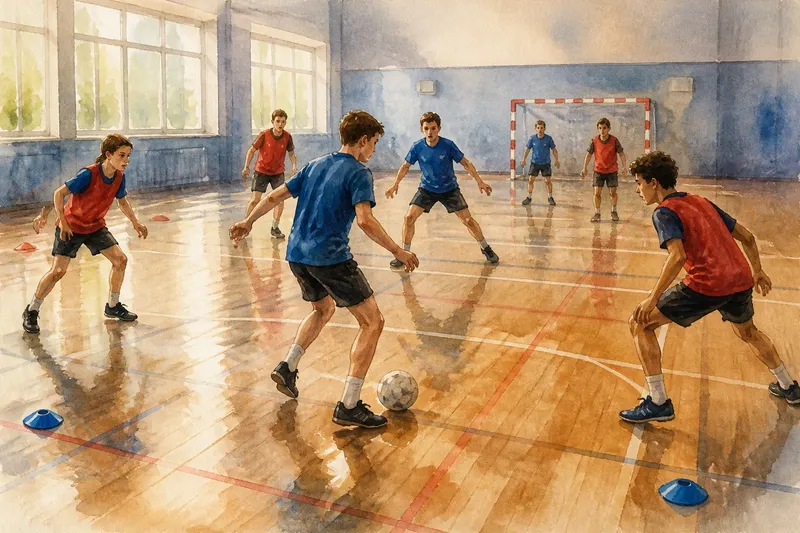
Why a smaller side changes the shape of a game becomes obvious when the ball reaches a player with nowhere useful to send it. With fewer players, each person covers more of the playing area, but there are also fewer teammates to offer a pass, protect space or recover possession. If a small-sided game feels cramped, frantic or oddly static, the cause is often the relationship between the number of players, the available space and the rules.
Use those three factors to diagnose trouble before adding a new rule. A smaller side does not automatically make a game faster or more skilful. It changes the decisions players face, and the effect depends on where they stand, how the ball moves and what happens after possession changes.
Why does the game feel crowded?
Crowding usually appears when the playing area has not been adjusted for the smaller group. Several players may converge on the ball because each is close enough to challenge, while nobody remains free to receive a pass. The result can look like a contest over one patch of ground rather than a game with useful routes forward.
Do not assume that fewer players always need a smaller area. A reduced side has fewer bodies occupying the space, so keeping the usual full-size area may leave large gaps and long distances between teammates. On the other hand, cutting the area sharply can bring everyone within reach of the ball at once. The useful space is the area in which players can support one another without being packed into the same channel.
- If players bunch around the ball: look at whether the area is too narrow or too short for the group to spread out.
- If a player in possession has no nearby option: check whether teammates have room to move into a passing lane, rather than simply asking them to run more.
- If the ball repeatedly leaves the playing area: consider whether the boundaries give the group enough room for its current pace and skill level.
Try changing one boundary at a time, then watch whether players can separate into useful positions. Widening an area can create sideways passing routes. Extending it can give a team room to move forward before meeting pressure. These are different changes, so avoid altering both at once if you want to understand what improved the flow.
Why do passes keep running out?
A smaller side has fewer immediate passing options. In a larger game, a player under pressure may be able to pass backwards, sideways or diagonally to different teammates. With fewer people on the field, one or more of those routes may not exist. The player then has to hold the ball, carry it into space or take a riskier pass.
That can produce repeated turnovers without meaning that players are careless. The passing network has become thinner: fewer players create fewer possible connections. Distance matters too. A teammate who is technically available may be too far away to reach with a controlled pass, or may be standing in a line where an opponent can intercept it.
Look for the point at which options disappear. If possession breaks down as soon as a player is pressed, the team may need a little more space or a rule that gives the receiver time to make a decision. If players have time but still face only one route, ask them to spread into different lanes before the ball arrives. A simple instruction such as “one short, one wide” can prompt two distinct passing options without prescribing a full formation.
Imagine a casual game in a school hall where each team has only a few players, and the ball carrier is repeatedly trapped against a side boundary. The organiser moves one boundary marker outwards, leaving the goal position and teams unchanged. If the next possessions include more sideways passes and fewer immediate traps, the extra width has created a usable outlet; if players still crowd the ball, their spacing may be the larger issue.
Why does the pace swing between slow and frantic?
Fewer players can make the ball travel quickly because there are fewer bodies between one end of the playing area and the other. A turnover may lead to an open route forward, and a player can cover substantial ground before meeting a defender. But fewer players also have more ground to protect. They may rush to close a gap, then find themselves out of position when the ball moves elsewhere.
Slow spells have a different cause. A team with few passing options may keep possession cautiously because every forward pass feels exposed. Players can also pause while they search for a teammate who is not available. In this situation, demanding a faster tempo may only increase mistakes; it does not create the missing options.
Separate the two problems by watching transitions. If the game becomes frantic immediately after possession changes, players may need clearer recovery positions or a little more room to turn and reorganise. If attacks stall before the ball moves, check whether teammates are offering distinct routes. Pace is not just how quickly someone runs. It is also how quickly the group can recognise and use its next option.
A useful comparison is a small table: with fewer objects, each one has more room to move, but there are fewer places to pass an object next. A game works similarly. Open ground can encourage direct movement, while a limited number of teammates can make each next pass harder to find.
What should change first when the game stops flowing?
Keep the adjustment small enough that players can feel its effect. Choose the symptom that is most persistent, make one change, and observe the next few possessions rather than changing the area, teams and rules together.
- Identify the main stoppage. Is play breaking down through crowding, missing passing options, long distances between teammates or hurried transitions?
- Check the space. Look at the length and width separately. Decide whether players need more room to spread, a shorter route to support one another, or clearer boundaries.
- Check the starting positions. If everyone begins near the ball, ask players to take up different lanes before play resumes. This adds options without adding people.
- Adjust one rule only if space and positioning are not enough. A temporary restriction on immediate challenges, for example, may give a receiver time to look up. Keep the rule simple and explain when it ends.
- Watch for the intended change. If you wanted more passing choices, look for additional receivers rather than merely counting passes. If you wanted calmer transitions, look for players recovering into useful positions.
- Undo or refine the change if a new problem appears. A wider area may ease crowding but make teammates too far apart. Bring the boundary back slightly or adjust positioning instead of layering on several rules.
For informal play, use cones or flat markers to make boundaries visible, and agree on what happens when the ball crosses them. If the group includes players with different confidence or mobility, ask whether the revised space and pace give everyone a fair chance to take part. That conversation can reveal a problem that is easy to miss while watching only the ball.
Which small-sided adjustment suits each problem?
Should the playing area get wider or longer?
Widen it when players lack sideways outlets or keep colliding in a narrow channel. Add length when the group needs room to move forward and defend without meeting pressure at once; change one dimension at a time so the effect stays clear.
Will adding a passing rule solve a lack of options?
Only if players already have somewhere useful to move. A rule requiring a certain type of pass can make play more predictable without creating a receiver, so improve spacing first and use a rule only to address a specific remaining blockage.
Why does a smaller side sometimes look less skilful?
Each player may be involved more often, leaving less time to recover after a rushed touch or misplaced pass. The smaller group can expose decision-making under pressure, but cramped space and limited support can make competent play difficult as well.
How can players avoid chasing the ball as a group?
Give teammates different jobs around possession: one can offer a short pass, another can stay wide, and another can remain ready to cover a turnover. Keep the instruction flexible, since the best position changes as the ball moves.
How can you tell whether the adjustment helped?
Watch for a change in the problem you set out to solve. More space should help players separate if crowding was the issue; a clearer starting position should produce more than one available pass; a simpler transition rule should make the next phase easier to read. These are visible signs, not a reason to assume the whole game has improved.
Ask players what they experienced as well. A pass may look available from the sideline but feel unreachable to the person receiving it. Keep feedback specific: “Could you see a second option?” is more useful than “Was that better?” If the answer is no, revisit the spacing or the distance between teammates rather than adding pressure to play faster.
For a group refining its small-sided game, the most useful adjustment is the one that restores a clear choice. More players create more possible links; fewer players create more responsibility per person and can leave larger openings. Match the space and any simple rule to the trouble you can actually see, then let players respond to the new shape before changing anything else.
That is the practical point behind why a smaller side changes the shape of a game: the number of players alters not only how much ground each person covers, but also how many routes the ball can take. Read those routes, and you can make a focused adjustment without pretending there is one ideal format for every group.